FDS Validation (NUREG 1934 Appendix B)
FDS Validation (NUREG 1934 Appendix B)
This case runs the U.S. NRC NUREG-1934 (EPRI 1023259), Appendix B — Cabinet Fire in a Switchgear Room through FRI3D's FDS pipeline, and compares it with NRC's own FDS deck for the case, both run in FDS 6.7.9. It is the FDS counterpart of the CFAST Appendix B validation, and extends the FDS Appendix A validation to a scenario with fire growth and spread.
FRI3D generates the FDS input from the plant model alone. During the run, FDS decides when the cable trays above the cabinet ignite and when their cables fail:
- The lowest tray ignites when the cabinet fire's flames reach it. FRI3D computes that time from the fire's heat-release curve. Alternatively, FDS's own THIEF cable in the tray failing first also ignites it.
- The trays above follow the FLASH-CAT stack schedule (NUREG/CR-7010).
- Each cable fails when FDS's THIEF cable model, read 2 mm inside the jacket, reaches the failure temperature (NUREG/CR-6931 Vol. 3).
At a glance
| Event | FRI3D FDS | NRC FDS | Difference |
|---|---|---|---|
| Lowest tray (3.9 m) ignites | 472 s | 553 s | −81 s |
| Middle tray (4.4 m) ignites | 712 s | 793 s | −81 s |
| Top tray (4.9 m) ignites | 892 s | 973 s | −81 s |
| Lowest tray's cable reaches 205 °C | 560 s | 553 s | +7 s |
| Middle tray's cable reaches 205 °C | 749 s | 711 s | +38 s |
| Top tray's cable reaches 205 °C | 834 s | 883 s | −49 s |
| Heat release at 1200 s | 1476 kW | 1493 kW | −1 % |
| Adjacent cabinets | not damaged | not damaged | — |
- Ignition. Both decks use the same FLASH-CAT schedule. They differ only in what lights the lowest tray. FRI3D lights it when the flames reach it, at 472 s, close to the 480 s NUREG-1934 gives for the same event. NRC's FDS deck waits for the cable under the tray to fail, at 553 s. So FRI3D's whole sequence runs 81 s ahead.
- Cables. The lowest tray's cable fails within 7 s of NRC's. The middle and top trays' cables fail 38 s later and 49 s earlier. A grid study shows why: those cables are heated by another tray's flames, which FRI3D's 0.2 m grid resolves less sharply than NRC's 0.1 m grid around the trays. With a 0.1 m mesh around the trays, FRI3D's deck brings the top tray's cable failure to within 5 s of NRC's and the middle tray's to within 47 s, counted from when the lowest tray ignites.
- Heat release and gas temperatures agree closely; the differences follow from the earlier ignition.
Reference case
The same room and fire as the CFAST Appendix B case:
- a 464 kW electrical cabinet fire in a 26.5 × 18.5 × 6.1 m switchgear room with 0.5 m concrete walls, floor and ceiling;
- three horizontal cable trays stacked 0.5 m apart above the cabinet;
- three supply and three return fans; the room is otherwise sealed.
The two FDS decks:
| Item | NRC FDS deck | FRI3D FDS deck |
|---|---|---|
| Source | NUREG-1934 CD, Switchgear_Room_Cabinet.fds (FDS 5), converted to FDS 6 | generated from FRI3D's NUREG-1934 Appendix B validation model |
| Cabinet fire | 464 kW, t² growth to 720 s, steady to 1200 s | same |
| Grid | 752,040 cells: 0.1 m around the fire and trays, 0.2 × 0.2 × 0.1 m elsewhere | 576,000 cells, 0.2 m |
| Simulated time | 1200 s | 1200 s |
| Solver | FDS 6.7.9, 3 MPI processes | FDS 6.7.9, 8 OpenMP threads |
NRC's deck was written for FDS 5. To run it in FDS 6 its cable model and combustion inputs were converted, keeping NRC's values. NUREG-1934 reports the lowest tray's cable failing at about 495 s in FDS 5; in FDS 6 it fails at 553 s. FRI3D is compared with the FDS 6 run, so both decks run the same solver.
Secondary ignition (FLASH-CAT)
Both decks model the burning trays the same way: a strip of each tray burns at a fixed heat release per unit area, and the burning area spreads along the tray in both directions.
| Item | NRC FDS deck | FRI3D FDS deck |
|---|---|---|
| Lowest tray ignites | when the THIEF cable under it reaches 205 °C | when the flames reach it (computed: 472 s), or when the THIEF cable under it reaches 200 °C, whichever is first |
| Middle tray ignites | 240 s after the lowest tray | 240 s after the lowest tray (FLASH-CAT: +4 min) |
| Top tray ignites | 420 s after the lowest tray | 420 s after the lowest tray (FLASH-CAT: +3 min more) |
| Initial burning length (low / middle / top) | 0.6 / 1.4 / 2.0 m | 0.42 / 1.12 / 1.82 m |
| Spread rate along the tray | 0.89 mm/s | 0.89 mm/s |
| Cable heat release per unit area | 250 kW/m² | 250 kW/m² |
| Burning of each tray segment | full after 127 s, out at 762 s | full after 134 s, out at 805 s |
- The initial burning length widens up the stack in both decks (FLASH-CAT's 35° spread). FRI3D starts from the width of its modelled fire and widens by 0.7 m per tray (0.5 m × tan 35° on each side). NRC starts from a 0.6 m strip and widens by 0.8 m, then 0.6 m.
- FRI3D computes each tray's burning time from the cable mass and heat of combustion in its cable library; it comes out 6 % longer than the time NRC's deck states.
Ignition times:
| Tray | FRI3D FDS | NRC FDS | NRC CFAST deck (prescribed) | FRI3D CFAST |
|---|---|---|---|---|
| 3.9 m | 472 s | 553 s | 480 s | 482 s |
| 4.4 m | 712 s | 793 s | 720 s | 722 s |
| 4.9 m | 892 s | 973 s | 900 s | 902 s |
What lit FRI3D's lowest tray:
| Criterion | First reached |
|---|---|
| Flame tip reaches the lowest tray | 472 s |
| THIEF cable under the lowest tray reaches 200 °C | 550 s |
FRI3D's flame-reach time agrees with the 480 s that NUREG-1934 and NRC's CFAST deck use. NRC's FDS deck lights the tray on its cable instead, which takes 81 s longer.
Results
Heat release rate
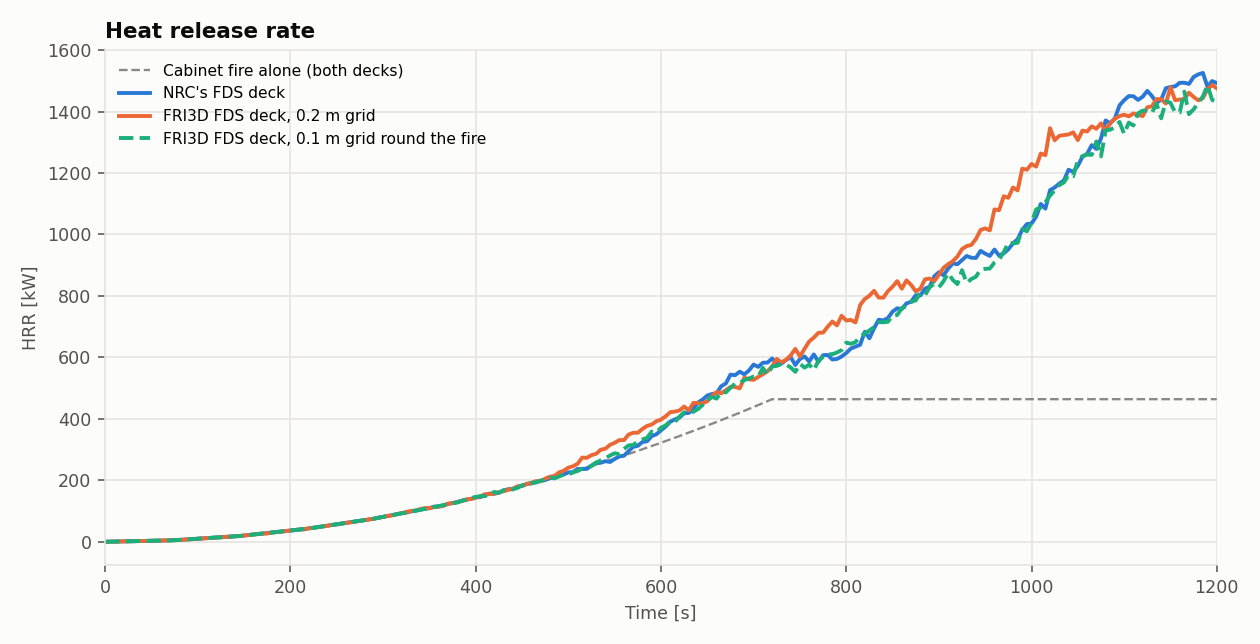
| Time | FRI3D FDS | NRC FDS | Difference |
|---|---|---|---|
| 300 s | 81 kW | 81 kW | 0 % |
| 480 s | 212 kW | 207 kW | +2 % |
| 600 s | 398 kW | 363 kW | +10 % |
| 720 s | 571 kW | 597 kW | −4 % |
| 900 s | 869 kW | 877 kW | −1 % |
| 1000 s | 1229 kW | 1036 kW | +19 % |
| 1100 s | 1390 kW | 1437 kW | −3 % |
| 1200 s | 1476 kW | 1493 kW | −1 % |
- Up to the first tray ignition the two decks burn the same cabinet fire.
- FRI3D lights each tray 81 s earlier, so it leads while a tray's fire grows (600 s, 1000 s). NRC catches up once the same tray is burning in both (720 s, 900 s, 1100 s), and then runs slightly higher because its deck starts each tray with a longer burning strip.
THIEF cable temperatures
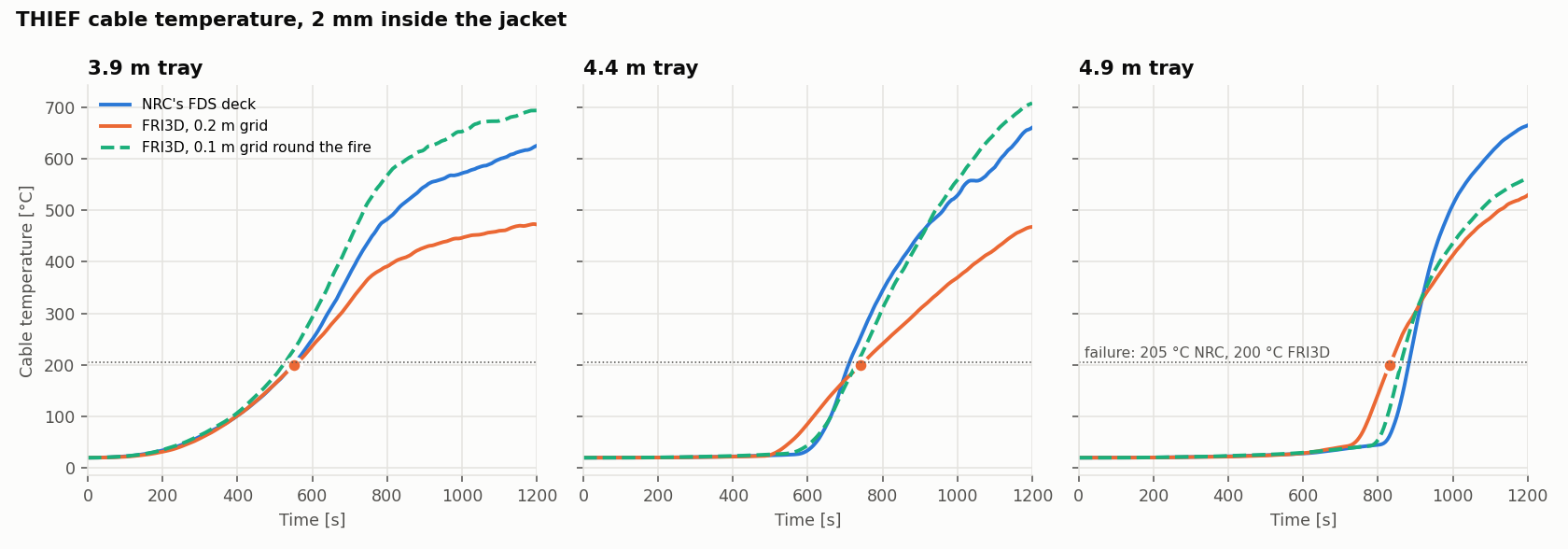
| Tray | FRI3D THIEF cable height | FRI3D reaches 205 °C | NRC THIEF cable height | NRC reaches 205 °C | Difference |
|---|---|---|---|---|---|
| 3.9 m | 3.7 m | 560 s | 3.8 m | 553 s | +7 s |
| 4.4 m | 4.3 m | 749 s | 4.3 m | 711 s | +38 s |
| 4.9 m | 4.7 m | 834 s | 4.8 m | 883 s | −49 s |
- Both decks place each THIEF cable just under its tray, above the cabinet fire, and read its temperature 2 mm inside the jacket.
- Lowest tray. Before it ignites, only the cabinet fire's plume heats its cable, and the two decks agree within 1 °C. The cable fails within 7 s of NRC's.
- Middle tray. Its cable fails before its own tray burns, heated by the lowest tray's flame 0.3 m below. FRI3D's flame starts 81 s earlier, but the cable heats at about a third of NRC's rate, so it fails 38 s later.
- Top tray. The same slower heating, but FRI3D's earlier middle-tray fire outweighs it, so the cable fails 49 s earlier.
- Once the trays burn, FRI3D's cables stay 100–160 °C cooler than NRC's.
Grid study
FRI3D's deck was run again with a single change: a 0.1 m mesh around the fire and the tray stack, as NRC's deck has. The lowest tray was lit the way NRC's deck lights it, on its cable, so both follow the same sequence. Like the other two runs, it covers 1200 s.
| FRI3D, 0.2 m grid | FRI3D, 0.1 m around the fire | NRC | |
|---|---|---|---|
| Lowest tray's cable 91 s after the tray ignites | 206 °C | 319 °C | 304 °C |
| Middle tray's cable fails, after the lowest tray ignites | 278 s | 205 s | 158 s |
| Top tray's cable fails, after the lowest tray ignites | 362 s | 334 s | 329 s |
| Heat release at 1200 s | 1476 kW | 1431 kW | 1493 kW |
- With the finer mesh, FRI3D's deck heats the cable in its own tray's flame as fast as NRC's deck.
- The middle tray's cable fails 205 s after the lowest tray ignites, against NRC's 158 s, closing 61 % of the gap. The remaining 47 s is consistent with NRC's room fire being larger at that point (578 against 506 kW), because NRC's deck lights the lowest tray later, into a bigger cabinet fire.
- The top tray's cable fails 334 s after the lowest tray ignites, against NRC's 329 s. The finer mesh closes 85 % of the gap.
- The heat release averages within 1 % of NRC's up to 900 s and ends 4 % below it (1431 against 1493 kW), because NRC's deck starts each tray with a longer burning strip. The 0.2 m run ends closer to NRC only because it lit its trays 81 s earlier.
- Once the trays burn, the cables sit inside the tray flames, and their temperature depends on exactly where each cable is in the flame. With the finer mesh, FRI3D's peak cable temperatures are within about 100 °C of NRC's, two higher and one lower. This happens after the cables have failed, so it does not affect the failure times.
So the cable differences come from the grid around the trays, not from how FRI3D builds the deck. A 0.1 m mesh around a cable tray stack reproduces NRC's cable heating.
Hot gas layer
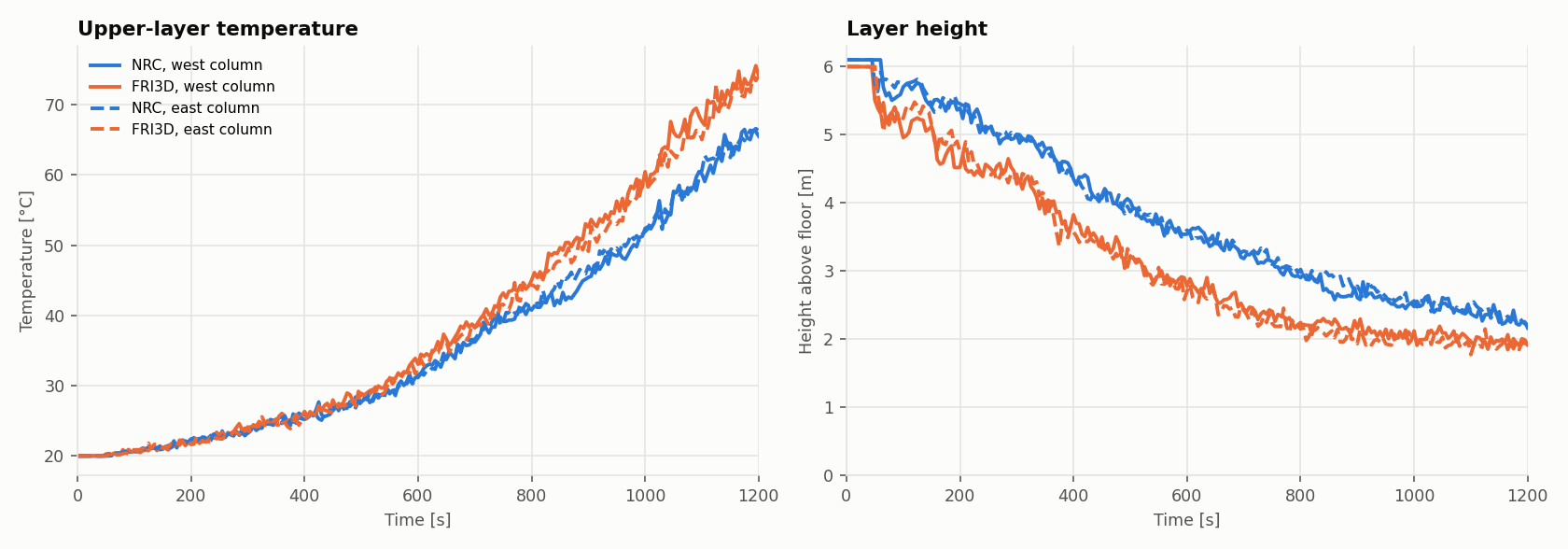
NRC's deck has no layer devices, so both decks' layers are computed the same way, from the same vertical plane through the fire, about 6 m to either side of it.
| Time | Layer height, FRI3D / NRC | Upper-layer temperature, FRI3D / NRC |
|---|---|---|
| 300 s | 4.3 / 5.0 m | 23 / 23 °C |
| 472 s | 3.3 / 4.0 m | 28 / 27 °C |
| 720 s | 2.4 / 3.2 m | 41 / 38 °C |
| 900 s | 2.2 / 2.6 m | 53 / 45 °C |
| 1200 s | 1.9 / 2.2 m | 74 / 66 °C |
- Temperature agrees within 1–3 °C until the trays burn. After that FRI3D runs up to 9 °C warmer, because its trays lit earlier and it has released 5 % more heat by the end.
- Height. FRI3D's layer sits 0.3–0.8 m lower, already before any tray burns. NRC's deck uses 0.1 m tall cells throughout the room, FRI3D's 0.2 m. Taller cells spread the boundary between the hot layer and the cool air below over more height, which reads as a lower layer. The walls, ventilation and fire are the same in both, and the finer mesh around the fire alone does not change the layer.
- The cables and cabinets sit in the fire's plume and flames, so the layer height does not affect their results.
Failure validation
NRC's Appendix B case defines failure for two kinds of item: the cables in the three trays, as THIEF targets failing at 205 °C, and the cabinets next to the burning one, which NUREG-1934 concludes are not damaged. FRI3D's failures are compared against both. The tray (raceway) and burning-cabinet failures have no NRC counterpart, so FRI3D's CFAST result is shown for reference.
Cables
| Tray | FRI3D FDS | NRC FDS | NRC CFAST deck (THIEF target) | FRI3D CFAST |
|---|---|---|---|---|
| 3.9 m | 552 s | 553 s | 630 s | 537 s |
| 4.4 m | 742 s | 711 s | 700 s | 640 s |
| 4.9 m | 832 s | 883 s | 840 s | 835 s |
- The cables fail in stack order, within 1, 31 and 51 s of NRC's FDS deck.
- FRI3D uses 200 °C, NUREG/CR-6931 Vol. 3's thermoplastic threshold, because the cable type in this model is unknown; NRC's deck uses 205 °C.
Cable trays
| Tray | FRI3D FDS | FRI3D CFAST | NRC |
|---|---|---|---|
| 3.9 m | 677 s | 506 s | not evaluated |
| 4.4 m | 815 s | 624 s | not evaluated |
| 4.9 m | 816 s | 818 s | not evaluated |
- A tray fails by the heat-soak method, which accumulates the tray's exposure to heat over time.
- NRC evaluates the cables in the trays, not the trays themselves.
- The two solvers compute that exposure differently: FDS from the temperatures and heat flux it resolves on the tray, CFAST from its fire-plume and smoke-layer formulas. FDS fails the lower two trays later than CFAST. The top tray, heated by both trays burning below it, fails at the same time in both.
Cabinets
| Cabinet | FRI3D FDS | NRC FDS | FRI3D CFAST | NRC CFAST deck |
|---|---|---|---|---|
| Burning cabinet | fails at 232 s | not evaluated (it is the fire) | fails at 48 s | not evaluated |
| Adjacent cabinets | not damaged; surface peaks 95 / 85 °C | not damaged; surface peaks 135 / 129 °C | not damaged; peaks 143 / 139 °C | not damaged; peak 137 °C |
- The adjacent cabinets stay well below the 205 °C damage threshold in both FDS decks, as NUREG-1934 concludes.
- NRC's FDS deck reads the hottest point anywhere on the adjacent cabinet rows, including their tops, which face the hot layer and the burning trays. FRI3D reads a 0.4 m patch on the side of each cabinet facing the fire, so it reads cooler.
- The burning cabinet's target sits just above the fire. CFAST's plume formula gives a flame temperature there even while the fire is very small (2 kW at 48 s). FDS spreads a small flame over a 0.2 m cell, so its target passes 205 °C once the fire has grown to about 50 kW, at 232 s.
Conclusion
From the plant model and the cable library alone, FRI3D's FDS pipeline writes the same secondary ignition logic as NRC's FDS deck: the same stack delays, spread rate and cable heat release. It ignites the lowest tray on flame reach, matching NUREG-1934's 480 s, where NRC's FDS deck waits for the cable to fail. Run in the same FDS version, the two decks agree on the heat release and on the lowest tray's cable failure within 7 s. The middle and top trays' cables fail within 50 s of NRC's, and a grid study shows the remaining difference comes from the mesh resolution around the trays. The adjacent cabinets are not damaged, as NUREG-1934 concludes.
Reference
- NUREG-1934 / EPRI 1023259, Nuclear Power Plant Fire Modeling Analysis Guidelines, Appendix B: Cabinet Fire in a Switchgear Room.
- NUREG/CR-7010 Vol. 1, Cable Heat Release, Ignition, and Spread in Tray Installations During Fire (CHRISTIFIRE), Phase 1: Horizontal Trays, §9.2: the FLASH-CAT model.
- NUREG/CR-6931 Vol. 3, Cable Response to Live Fire (CAROLFIRE), Volume 3: Thermally-Induced Electrical Failure (THIEF) Model.